
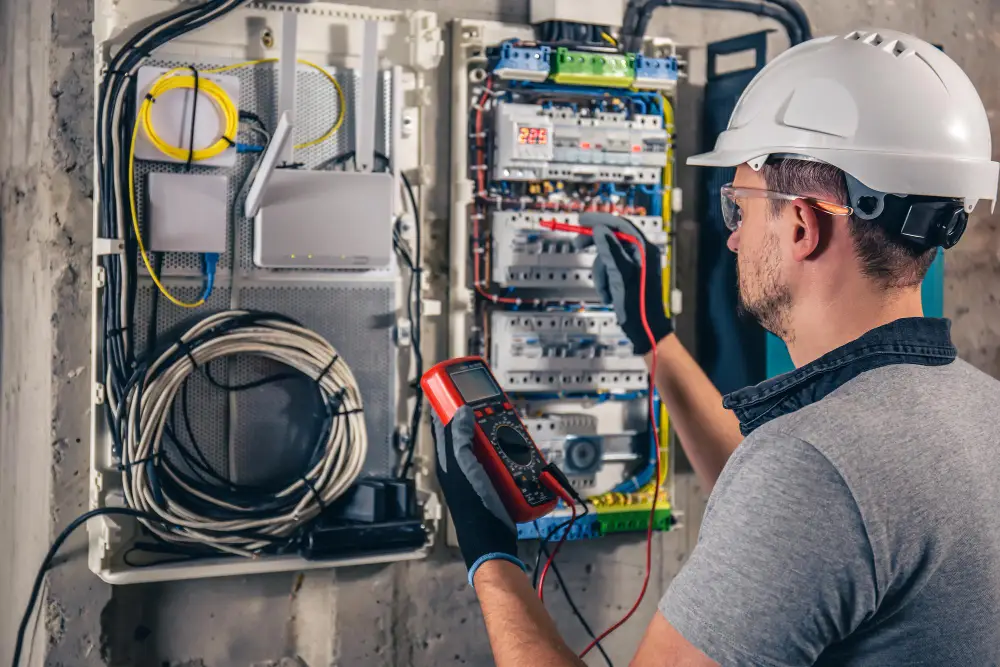
Why does your breaker keep cutting off the electricity, and is that unsafe? Usually, circuit breaker tripping means your breaker is safely protecting the circuit as intended. It cuts power when a circuit is overloaded, shorted, or leaking current, which protects your wiring from overheating. A single trip is usually harmless. A breaker that keeps tripping needs a proper inspection, not another reset. Something in the wiring or load is causing it.
At Dar Al Tarmeem, we handle maintenance for office, retail, industrial, and residential properties across Sharjah and Dubai. Our electricians see this issue every week, especially in summer when air conditioners run nonstop. This guide explains the common causes, what you can safely check yourself, and when to call a professional.
What Does Circuit Breaker Tripping Actually Mean?
A circuit breaker is a safety switch. It watches the current flowing through a circuit, and when something goes wrong, it “trips” (switches off) to stop the flow of electricity.
A trip is an alert from the system, not proof that the breaker is broken. If your circuit breaker keeps tripping, something on that circuit is drawing too much power, leaking current, or is damaged.
There are three main types of trips:
| Type of Trip | What Happens | Typical Risk Level |
| Overload | Too many devices draw power at once | Moderate |
| Short circuit | Live and neutral wires touch | High |
| Ground fault | Current leaks to earth or water | High |
Common Causes of Circuit Breaker Tripping
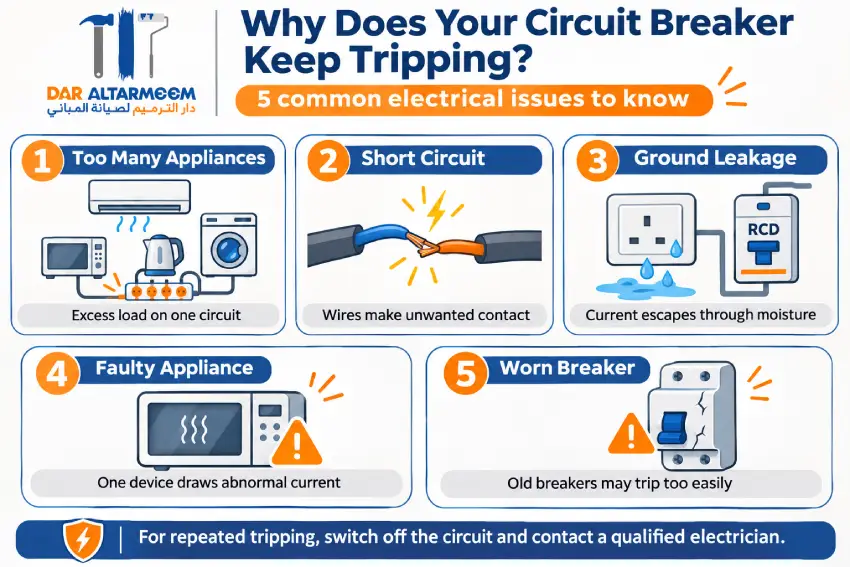
1. Circuit Overload
This is the most common reason. Running an AC unit, a water heater, a kettle, and a microwave on one circuit can easily push it past its limit. Offices see this when extra computers and printers are plugged into the same line.
2. Short Circuit
A short circuit forms once a live wire meets a neutral wire. The current spikes instantly and the breaker trips right away, often with a loud click. Damaged insulation, loose connections, or rodents chewing cables are typical culprits.
3. Ground Fault
A ground fault occurs when electricity escapes its normal path, often through moisture. Bathrooms, kitchens, and outdoor sockets are the usual spots. Residual current devices (RCDs) trip for this reason.
4. Faulty Appliances
A worn-out appliance can draw abnormal current. If the breaker trips only when you switch on one particular device, that device is probably the problem.
5. A Worn or Faulty Breaker
Breakers age. After years of use, especially in hot conditions, they can become weak and trip at normal loads.
What Makes Your Breaker Keep Tripping in Sharjah and Dubai?
Local conditions make things worse. High temperatures push AC systems to work harder for months. Humidity and dust can affect connections, and older buildings often have wiring that was never designed for today’s electrical demand.
If your breaker keeps tripping during the hottest months, the AC circuit is the first place to look. Commercial spaces face extra pressure because lighting, servers, and cooling all run for long hours.
Poor connections can also create heat inside the panel. Loose wiring is one of the common electrical wiring problems we find during inspections in Sharjah, and it often shows up first as unexplained trips.
How to Fix Circuit Breaker Tripping Safely
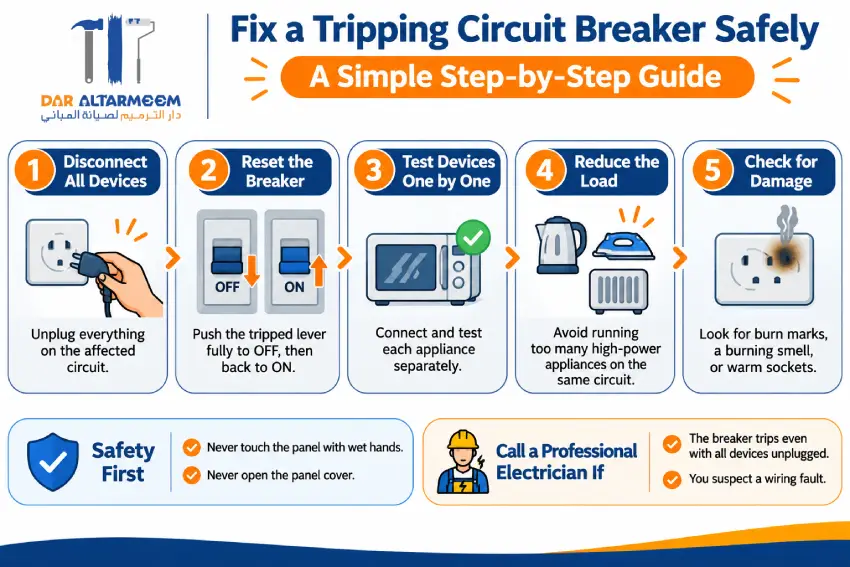
You can try a few simple steps, but safety comes first. Never touch the panel with wet hands, and never open the panel cover.
Step-by-Step Checks You Can Do
Step 1: Unplug everything on the affected circuit.
Step 2: A tripped lever often stops in the middle, so push it fully to OFF before turning it back ON again.
Step 3: Test each appliance separately by switching it on alone. Whichever appliance sets off the trip is probably what’s causing the fault.
Step 4: Reduce the load. Move high-power appliances to different circuits.
Step 5: Check for signs of damage, such as burn marks, a burning smell, or warm sockets.
Does it trip even with every device unplugged? Stop resetting it. The wiring is probably faulty, so call a licensed electrician.
What You Should Never Do
| Don’t | Why |
| Replace the breaker with a higher-rated one | Wires can overheat and cause a fire |
| Keep resetting a breaker that trips instantly | It may be a short circuit |
| Tape down or bypass the switch | It removes your safety protection |
| Open the electrical panel yourself | Live parts can cause serious injury |
When Should You Call a Professional?
Call an electrician if you notice any of these:
- The breaker trips immediately after you reset it
- You smell burning or see scorch marks near the panel or sockets
- The panel feels hot to the touch
- Lights flicker regularly
- You hear buzzing or crackling from the panel
- The same breaker has tripped several times in a week
These signs can point to loose connections, damaged cables, or an aging panel. Trying a DIY fix here is risky.
Our team offers dependable Electrical Maintenance Services in Sharjah, covering inspection, load testing, wiring checks, and breaker replacement. Our team traces the actual fault rather than simply flipping the breaker back on.
For approved electrical standards and safety guidance, you can also visit the Sharjah Electricity, Water and Gas Authority (SEWA).
How to Prevent Circuit Breaker Tripping
Prevention costs far less than emergency repairs. Simple routines can prevent bigger problems:
- Spread your load. Don’t power several high-wattage appliances from a single circuit.
- Schedule regular inspections. A yearly check catches loose connections early.
- Replace old appliances that draw extra power.
- Use surge protection for sensitive electronics.
- Install a higher-capacity panel if your property now runs more equipment than before.
Regular servicing also lowers the chance of sudden blackouts. You can read more in our guide on how maintenance prevents power outages.
For businesses, a planned maintenance routine helps avoid downtime during working hours, which protects both revenue and equipment.
Conclusion
Circuit breaker tripping is your wiring’s signal that something needs checking. Occasional trips from overload are usually easy to solve by spreading your load. Repeated or instant trips are a different story, and they should never be ignored.
Stay safe, avoid risky shortcuts, and bring in a professional when the signs point beyond a simple fix. If your breaker keeps tripping at home or at work, Dar Al Tarmeem is ready to help. Our team will inspect your system, find the cause, and fix it properly, so you get power you can trust.
Ready to get it checked? Book our Electrical Maintenance Services in Sharjah today.
Frequently Asked Questions
1. Why does my circuit breaker keep tripping when nothing is plugged in?
If a breaker trips with no load, the cause is usually a wiring fault, a short circuit, moisture in the line, or a worn breaker. Stop resetting it and call an electrician.
2. Is it dangerous if my breaker keeps tripping?
It can be. Overloads are often manageable, but repeated tripping can signal damaged wiring or a short circuit, both of which raise the risk of overheating and fire.
3. Can a circuit breaker go bad?
Yes. Breakers wear out over time, especially in hot climates. A weak breaker may trip at normal loads or fail to trip when it should, which is more serious.
4. How do I stop my circuit breaker from tripping when I use the AC?
Make sure the AC has its own dedicated circuit, and keep other heavy appliances off it. Clean the filters and service the unit regularly, since a struggling AC draws more current.
5. How much does it cost to fix circuit breaker tripping in Sharjah?
The cost depends on the cause. Moving a load is free, while rewiring or replacing a panel costs more. A professional inspection gives you an accurate quote.